
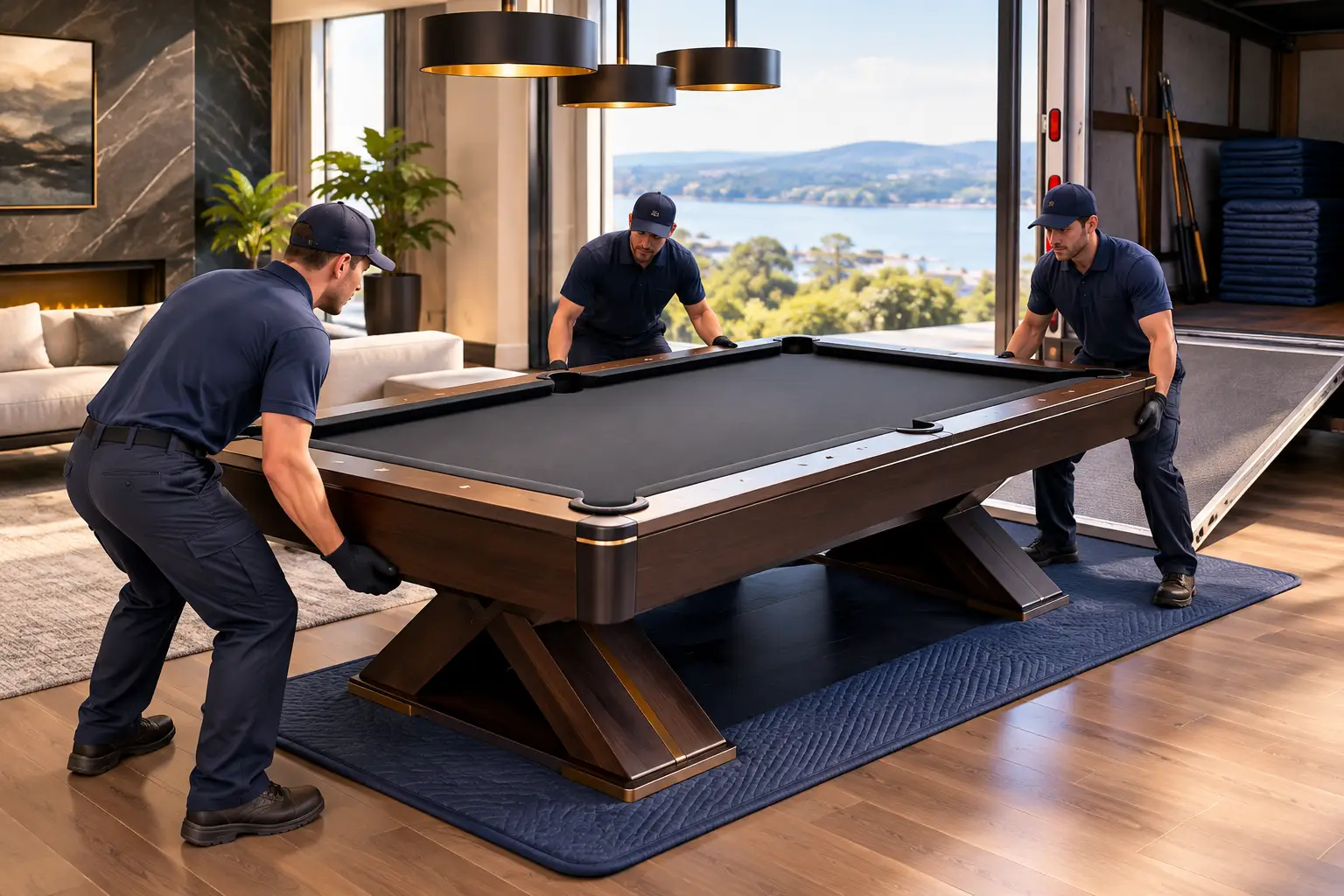
A Westchester billiard delivery example is rarely as simple as getting a large table through the front door. A slate pool table is a precision piece of equipment made of heavy, separate components: cabinet, legs, rails, pockets, hardware, and one to three slate sections. The real measure of a successful delivery is what happens after transport. Does the table sit solidly? Do balls roll true? Are the rails tight, the cloth clean, and the playing surface level?
For a homeowner buying a used table, moving to a new house, or finishing a game room renovation, those details determine whether the table becomes a source of enjoyment or an expensive problem. Professional pool table relocation services protect both the table and the experience of playing on it.
A Westchester Billiard Delivery Example From Start to Finish
Consider a typical residential move: a family purchases a used 8-foot, three-piece slate pool table from another homeowner in Westchester. The table looks good in the seller's basement, but it must travel through a stairway, across a driveway, and into a newly renovated room at the buyer's home.
The first decision is the one that prevents most damage: the table is not moved as a complete unit. Even smaller home tables are too heavy and too vulnerable to be carried intact. The weight is uneven, frames can twist, legs can loosen, and slate can crack if the table is lifted or tipped incorrectly. The table needs to be professionally disassembled before it goes anywhere.
The process begins with documenting the existing setup and inspecting the table. I look for loose rail bolts, frame damage, worn cushions, old cloth, cracked slate seams, and prior repairs that may affect reassembly. This inspection is valuable because a move can reveal problems that were hidden beneath the cloth or inside the cabinet.
Next, the pockets and rails come off. Rail bolts are removed carefully so the rail assembly can be protected during transport. The existing cloth is then evaluated. If it is in excellent condition and the customer wants to keep it, it may be possible to preserve it. In many cases, however, moving a table is the right time to install new cloth. Old cloth can stretch, show fading, or carry marks from years of play. Fresh felt gives the reinstalled table a clean appearance and a more consistent roll.
Once the cloth is removed, the slate sections are exposed. On a three-piece table, each piece is separated, supported, and wrapped for transport. This is where experience matters most. Slate is durable when properly supported, but it is not indestructible. An edge strike, a poorly supported lift, or a sudden drop can turn a routine delivery into a costly repair.
Transport Is About Protection, Not Just Muscle
A pool table cabinet can be bulky, but the slate is the critical component. Each section needs stable handling from the game room to the vehicle and from the vehicle into the new space. Doorways, turns, steps, finished floors, and narrow basement access all affect the moving plan.
A good delivery team does not arrive and improvise. Before the move, the access route should be considered: which entrance provides the safest path, whether the stairway has enough clearance, how flooring will be protected, and where components can be staged without blocking the work area. A table that fits comfortably in a finished basement may still require careful maneuvering to get there.
There are trade-offs. A ground-level installation with wide access may move quickly, while a table going into a lower-level room with tight turns requires more time and planning. Homeowners should be cautious about choosing a service based on the lowest estimate alone. The lower price can disappear quickly if a rushed crew damages a rail, chips a slate edge, scratches finished flooring, or leaves the table playing poorly after assembly.
At TableSmith Installations, I treat transport as part of the craftsmanship, not a separate chore. The goal is to bring every component into the new game room in the condition needed for a proper rebuild.
Reassembly Is Where the Table Starts to Play Again
After delivery, the base frame is assembled and positioned in its final location. This is the point when room planning becomes practical. A table needs more than enough floor space for its outside dimensions. Players need room to make a comfortable stroke from every side. If the table is too close to a wall, even an otherwise beautiful game room will feel cramped during play.
The cabinet is leveled first, but that is only the beginning. The slate goes back onto the frame section by section, and each seam is aligned. On many tables, the seams are filled and finished so they do not telegraph through the cloth. The objective is a single, stable playing plane, not three separate pieces that happen to sit next to one another.
Precision leveling requires more than a quick check with a basic level. A table can appear level in one direction while still allowing balls to drift on a slow shot. Proper leveling means checking across the surface, adjusting the frame and slate as needed, and confirming the finished result through careful testing. Temperature, flooring type, and the condition of the home can all affect the setup. A finished basement concrete floor behaves differently from an older wood floor, and both require attention.
The rails are then installed and tightened evenly. Rail alignment affects pocket openings, cushion response, and the overall feel of the table. If the rails are loose or uneven, the table may look assembled but will not play correctly. For players who care about bank shots, speed, and accurate pocket geometry, this is not a cosmetic detail.
Delivery Can Be the Right Time for Repairs
A move gives owners a practical opportunity to address parts that are difficult to reach once the table is assembled. New cloth is the most common upgrade, but it is not the only one. Dead cushions, worn pocket liners, loose leg mounts, damaged veneer, and compromised frame supports can often be repaired or restored during the same service appointment.
Rubber cushions deserve particular attention. Over time, cushion rubber can harden, lose elasticity, or pull away from the rail. The symptom is familiar: a ball hits the rail and responds with an inconsistent or dull rebound. Replacing cushion rubber during reassembly can make an older table far more enjoyable to play.
Cloth selection also depends on how the table will be used. A family game room may benefit from a durable cloth color that works with the room's design and stands up to regular use. A more serious player may prefer a faster, tighter weave for improved speed and consistency. Neither choice is automatically better. The right cloth is the one that fits the owner's playing habits, maintenance expectations, and budget.
What Homeowners Can Do Before Delivery Day
The best preparation is simple: clear the route, clear the room, and make final layout decisions before the crew arrives. Remove fragile wall décor near stairways and doorways, create a path from the entrance to the installation space, and make sure the table location is not directly over a floor register or unstable surface.
It also helps to measure the room with cue clearance in mind. An 8-foot table may physically fit in a room that is still too tight for standard cues. Shorter cues can solve limited-space situations, but they are a compromise. If the room is close to the minimum size, discussing the layout before the installation can prevent disappointment after the table is assembled.
If the table is being purchased from a seller, ask whether it is one-piece or three-piece slate, whether there are known issues, and whether accessories are included. Photos of the table, stairs, entrances, and final room can help identify potential challenges early. Honest information makes for a safer, more accurate plan.
A well-handled billiard delivery should leave you with more than a table placed in a room. It should leave you with a solid playing surface, properly fitted rails, and the confidence that your investment was transported and rebuilt with the care it deserves. Before scheduling your move, take a few minutes to consider how you want the table to play when the first rack is broken.