
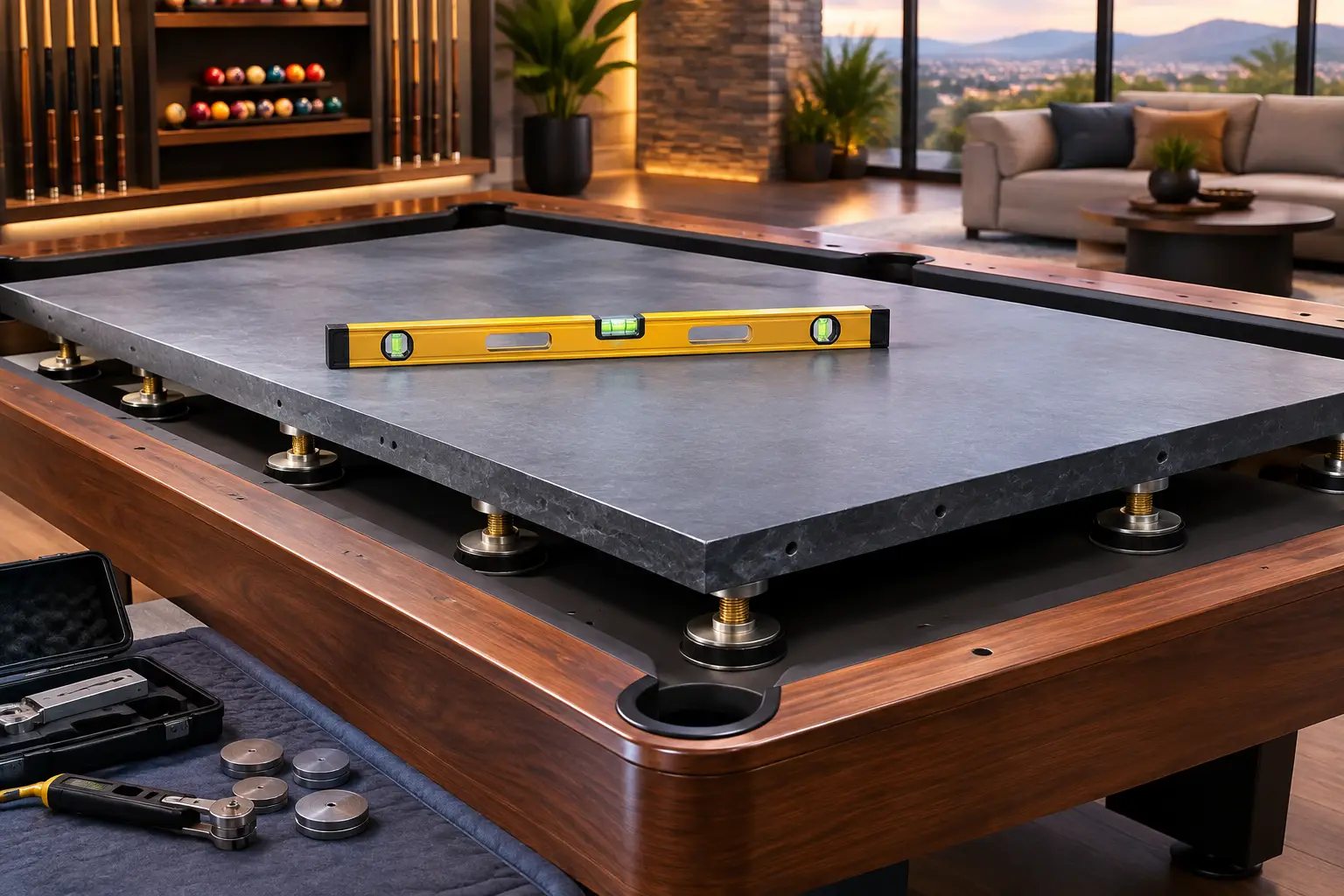
A pool table can look perfectly level and still play wrong. A ball that slowly drifts off line, breaks that favor one side, and shots that die near a slate seam are all signs that slate leveling needs more attention than a quick adjustment to the legs. On a quality billiard table, the playing surface is a precision assembly. Getting it right protects the table and makes every rack play the way it should.
Why Slate Leveling Matters More Than Leg Adjustment
Most residential pool tables are built with one-piece or three-piece slate. The slate creates the true playing surface, while the cabinet, frame, legs, and floor support it from below. Those parts all matter, but they do not perform the same job.
Adjustable leg levelers can help compensate for a minor floor variation. They cannot correct a slate panel that has shifted, a seam that is sitting high, a loose frame connection, or a cabinet that has been twisted during a move. Raising one corner of a table may make a carpenter's level look better while leaving the actual playing surface out of plane.
That distinction is where professional work pays off. A table must be supported evenly, its frame must be square and stable, and the slate sections must meet flush before final leveling begins. If the base is unstable, the table can change as weight settles onto it. If the slate seams are not properly aligned, balls can react differently as they cross the table.
For casual family play, even a small roll can become frustrating. For players who practice position play or expect a clean bank angle, it changes the game entirely. Accurate leveling is not cosmetic finishing work. It is the foundation of how the table performs.
What a Proper Slate Leveling Service Addresses
A precise setup starts before anyone reaches for a level. The installer first evaluates the room, floor, table frame, and hardware. Many homes have floors that slope slightly or flex under concentrated weight. That does not automatically make the room unsuitable for a pool table, but it does affect how the table must be supported.
The cabinet and frame
The cabinet needs to sit firmly without rocking. Bolts, cross members, and slate-support beams need to be secure and correctly positioned. On older tables, worn hardware, damaged wood, or previous assembly mistakes can show up only after the table is opened up. Correcting those concerns before the slate is finalized prevents a recurring leveling problem.
The slate sections and seams
Three-piece slate tables require careful handling and alignment. Each piece is heavy, brittle at the edges, and intended to meet the next piece with minimal variation. Installers position the panels, bring the seams flush, and check the surface repeatedly across its length, width, and diagonals.
The seams are then filled and finished so the cloth has a smooth foundation. A poorly prepared seam can telegraph through the cloth, create a noticeable line, or interfere with a slow-rolling ball. Fresh cloth will not hide a bad slate seam for long.
Fine adjustments under the slate
Once the frame and slate are correctly positioned, fine adjustments are made at the slate support points as needed. This is often where shims are used. A shim is not a shortcut when it is selected and placed correctly. It is a controlled way to bring a section of slate into the same plane as the rest of the playing surface.
The key is restraint and accuracy. Randomly stacking material under a corner can create pressure points or leave the slate inadequately supported. Proper shimming works with the table's structural design instead of fighting it.
Verification from more than one direction
A single level placed in the center of the table does not tell the whole story. The surface should be checked in multiple locations and directions, including across seams and near the rails. A skilled installer also watches how the table behaves after the cloth and rails are installed, because rail hardware can affect the final assembly if it is overtightened or improperly seated.
Signs Your Pool Table May Need Slate Leveling
Some issues are obvious, while others develop gradually. The most common sign is a ball that consistently rolls toward the same area when hit softly from different positions. A fast shot may travel straight enough to hide a minor issue, so slow-roll testing is more revealing.
You may also notice that a ball hesitates or changes direction near the center of the table. That can point to a seam issue, cloth damage, debris beneath the cloth, or a low spot that needs closer inspection. A table that rocks when pressure is applied to a rail needs attention before regular use continues.
After a move, it is wise to assume the table needs to be reassembled and leveled rather than simply placed in the new room. Even if it traveled only a few miles, the slate, frame, and rails have been separated from their original setup. Pool tables are not designed to be moved as assembled furniture.
Seasonal changes can matter too. In older homes, wood framing and flooring can shift slightly with humidity and temperature. A table that once played true may need a follow-up adjustment, particularly if the floor beneath it has settled or a renovation changed the room structure.
Why a Bubble Level Alone Is Not Enough
A standard bubble level is useful, but it is only one part of the process. It can show a general slope, yet its accuracy depends on the tool, the length of its body, and where it is placed. A short level may miss gradual variation across a nine-foot table. A level placed over cloth can also be influenced by the cloth's texture or an underlying seam.
Professional slate leveling combines accurate instruments with practical ball-roll testing and experience reading the table's structure. The goal is not simply to center a bubble. The goal is to create a stable, consistently responsive playing surface.
There is also a difference between a table that is level at the moment of installation and one that stays level. If the support points are not secure or the floor is allowed to flex, an initial adjustment may not last. Taking time to prepare the base is what gives the finished setup staying power.
Leveling During Refelting, Repair, and Restoration
Refelting is an ideal time to inspect slate leveling because the playing surface is already exposed. If cloth is worn, torn, or being upgraded, it makes sense to check seams, slate screws, frame condition, and rail alignment before new material is installed.
The same is true during restoration work. A table with faded finish, damaged cushions, loose rails, or aging hardware may need more than fresh cloth. New rubber cushions will improve rebound, but they cannot compensate for a table that is out of level. Tight rails will feel better, but the benefits are limited if balls drift before they ever reach a cushion.
Handling these details together creates a better result and avoids paying to remove new cloth later for an issue that should have been corrected first. TableSmith Installations approaches the table as a complete playing system, not a collection of separate repairs.
Can You Level a Slate Pool Table Yourself?
For a minor check on a table that is already assembled, an owner can verify whether the cabinet is rocking and test a few slow rolls. If the table has adjustable leg levelers and the issue is clearly a small floor-related change, a careful adjustment may help.
Full slate leveling is different. It involves heavy slate, precise seam alignment, specialized support methods, and a real risk of damaged cloth, cracked slate, stripped hardware, or a frame that is no longer properly supported. Three-piece slate in particular should not be treated as a simple do-it-yourself project.
The trade-off is straightforward. Doing a small diagnostic check yourself may help you identify a problem. Trying to correct slate, seams, or structural support without the right equipment can turn a manageable service appointment into a larger repair. When a table has been moved, newly purchased, refelted, or showing consistent play issues, professional installation is the safer choice.
A pool table should reward a well-aimed shot, not make you guess whether the floor is deciding the outcome. If the roll feels questionable, have the surface checked before the next game room gathering turns into an argument over a ball that had a mind of its own.