
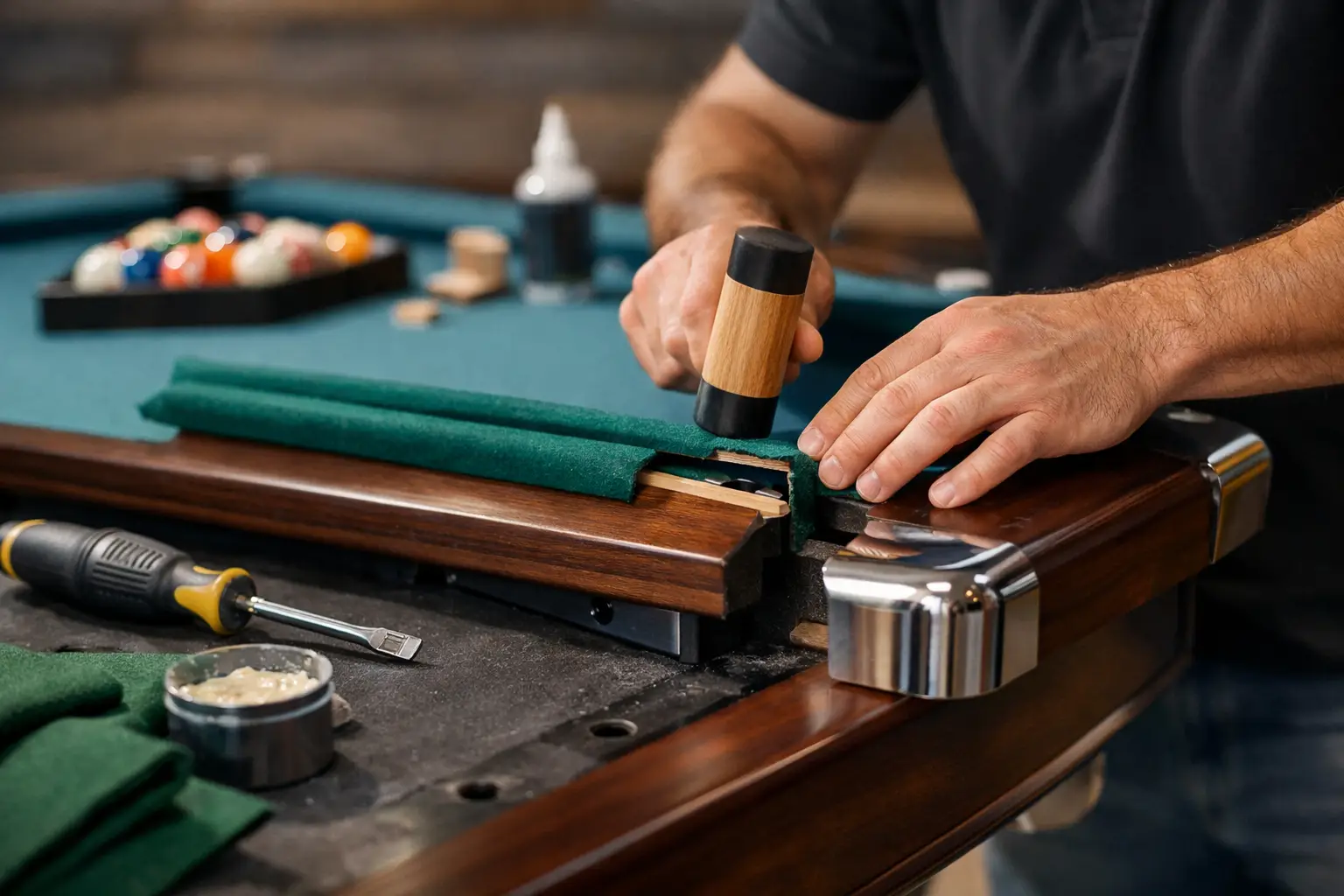
A rail problem announces itself at the worst possible moment: a clean shot reaches the cushion, then dies, thumps, or kicks away at an angle that makes no sense. Knowing how to repair pool table rails starts with identifying which part of the rail assembly has failed. The visible wood rail, cushion rubber, facing, cloth, bolts, and mounting hardware all affect how a ball rebounds. Treating the wrong one can turn a manageable repair into an expensive rebuild.
For homeowners, the goal is not simply to make a table look better. A sound rail system keeps pocket openings consistent, cushions responsive, and the entire table enjoyable to play. Some repairs are reasonable for a careful owner. Others require disassembly, accurate reinstallation, and a close eye on rail geometry.
Start by identifying the rail problem
Before removing a bolt or pulling up cloth, test each rail. Roll a ball gently and then firmly into several points along every cushion. A healthy cushion returns the ball with a lively, reasonably consistent rebound. It should not feel hollow, dead, overly soft, or dramatically different from one end of the same rail to the other.
Then inspect the rail assembly by hand. A rail that moves when you press down on it may have loose mounting bolts, stripped threads, damaged rail wood, or an issue below the slate. If the rail feels solid but the ball dies on contact, the cushion rubber is the likely suspect. If the table plays well but looks tired around the edges, the cloth or pocket facings may be the real repair.
Watch for these common signs:
A ball makes a dull thud and barely returns after striking the cushion.
The cushion is hard, cracked, detached, or has a wavy surface beneath the cloth.
One rail sits higher, lower, or farther into the playing area than the others.
The rail cloth is loose, torn, faded, or pulling away near a pocket.
Pocket openings look uneven, or a ball rattles at one pocket more than the others.
A table can have more than one issue. Old cushion rubber often appears alongside worn cloth and loose pocket facings, especially after years in a basement, garage, attic, or room with major temperature swings.
How to repair pool table rails with loose hardware
Loose rails are often the most straightforward repair, but they still deserve care. Most residential pool table rails fasten to the slate from underneath with rail bolts. Access usually requires removing the ball return components or working carefully beneath the table. The bolts may pass through the slate, or they may secure into threaded inserts depending on the table’s design.
First, confirm that the rail is actually loose. Sometimes the rail feels unstable because the table frame is shifting or the table is not level. Check the table legs, frame connections, and slate support before tightening anything. Tightening rail bolts on a table with a moving frame can mask the real problem.
If the rail bolts are accessible, tighten them gradually and evenly. Do not crank one bolt down as hard as possible while leaving the others loose. Excess force can damage threaded inserts, crush a compromised wood rail, or place stress on slate. Work around the rail in small increments until it is secure and aligned.
After tightening, check the pocket openings and the rail’s position relative to the slate. A rail that has shifted inward even slightly can change the difficulty of a shot. If bolts will not tighten, spin freely, or pull through damaged wood, stop there. The repair may require rebuilding the rail mounting area, replacing inserts, or correcting a structural issue in the cabinet.
Replace dead or hardened cushion rubber
Cushion replacement is one of the most important rail repairs because the rubber controls the table’s response. Good cushion rubber has a firm, resilient feel. It should not be brittle, rock hard, sticky, separated from the rail, or flattened along its face.
Rubber commonly fails because of age, heat, humidity, and improper storage. The cloth can look perfectly acceptable while the rubber underneath has lost its life. A dead cushion cannot be corrected by tightening bolts or stretching the cloth. It needs replacement.
Why cushion replacement is more precise than it looks
Replacing cushion rubber means removing the rails, stripping back the rail cloth, removing old adhesive and rubber, and installing new cushions at the correct height and angle. The rubber profile must suit the table. A mismatch can change where the ball contacts the cushion, creating weak rebounds or unnatural bank angles.
The new rubber must also be attached in a straight line, with clean transitions at the pocket ends. Even a small alignment error can affect play down the full length of a rail. Once the adhesive cures, the cushions need new facings and properly installed rail cloth before the rails return to the table.
This is usually not a good shortcut project. Household adhesives, incorrect rubber profiles, and uneven trimming can leave a table looking repaired but playing poorly. If the table matters to you, cushion replacement is where professional craftsmanship pays off.
Repair rail cloth, facings, and pocket edges
Rail cloth takes more abuse than many owners realize. Hands rest on it, cues brush it, balls strike near pockets, and years of chalk dust work into the fibers. Loose rail cloth can catch a ball, reveal wrinkles, or expose uneven cushion contours. Torn cloth around a pocket can worsen quickly because the edge is constantly under tension.
Small cloth issues may be repairable if the material is otherwise in good shape and there is enough slack to resecure it. Usually, though, loose or damaged rail cloth is a sign that replacement is the cleaner solution. Rail cloth has to be stretched evenly so it follows the cushion shape without wrinkles, thin spots, or distorted pocket cuts.
Pocket facings deserve equal attention. These are the small pieces of material at the pocket openings that help guide balls into the pocket and protect the cushion ends. A missing, hard, or poorly fitted facing can make a pocket reject shots inconsistently. Replacing facings requires matching their thickness and shaping them carefully so the pocket remains symmetrical.
Do not treat facings as cosmetic trim. They are part of the table’s playing geometry.
Check rail alignment before calling the job finished
Once a rail is repaired or reinstalled, inspect it from above and below. The rails should sit tight against the slate, the pockets should look balanced, and the playing surface should not show gaps along the cushion line. A ball rolled slowly along the rail should travel smoothly without clipping cloth, facing material, or a shifted cushion edge.
Test banks from several locations, not just one easy shot. You are looking for consistency between opposite rails and from one end of a long rail to the other. Perfect tournament-level calibration is not always realistic on every older home table, particularly one with worn wood or previous repairs. But obvious dead spots, unusually sharp rebounds, and unequal pocket openings should be corrected before the project is considered complete.
It is also wise to recheck table level. Rail work can reveal an existing leveling problem that was hidden by poor cushion response. If balls drift on a slow roll, the issue may be slate level rather than the rail itself.
When a rail repair should be left to a specialist
Call for help when the repair involves hardened cushions, cracked or warped rails, stripped mounting points, slate-related alignment issues, or a full rail cloth replacement. These jobs are connected. A rail can be installed tightly and still play wrong if the cushion height, facing thickness, or slate alignment is off.
That is especially true for slate tables that have been moved, inherited, or purchased used. Their condition is not always obvious until the rails come off. A qualified technician can assess the frame, slate seams, bolt hardware, cushion profile, and pocket geometry as one system rather than addressing a single symptom.
At TableSmith Installations, I approach rail work as performance work, not furniture repair. The aim is a table that looks cared for and gives you reliable rebounds, true pocket lines, and a playing surface worth gathering around.
A pool table does not need to be brand new to play beautifully. Give a loose rail attention before it damages the cloth or changes the way the table plays, and give dead cushions the proper repair instead of learning to compensate for them shot after shot.