
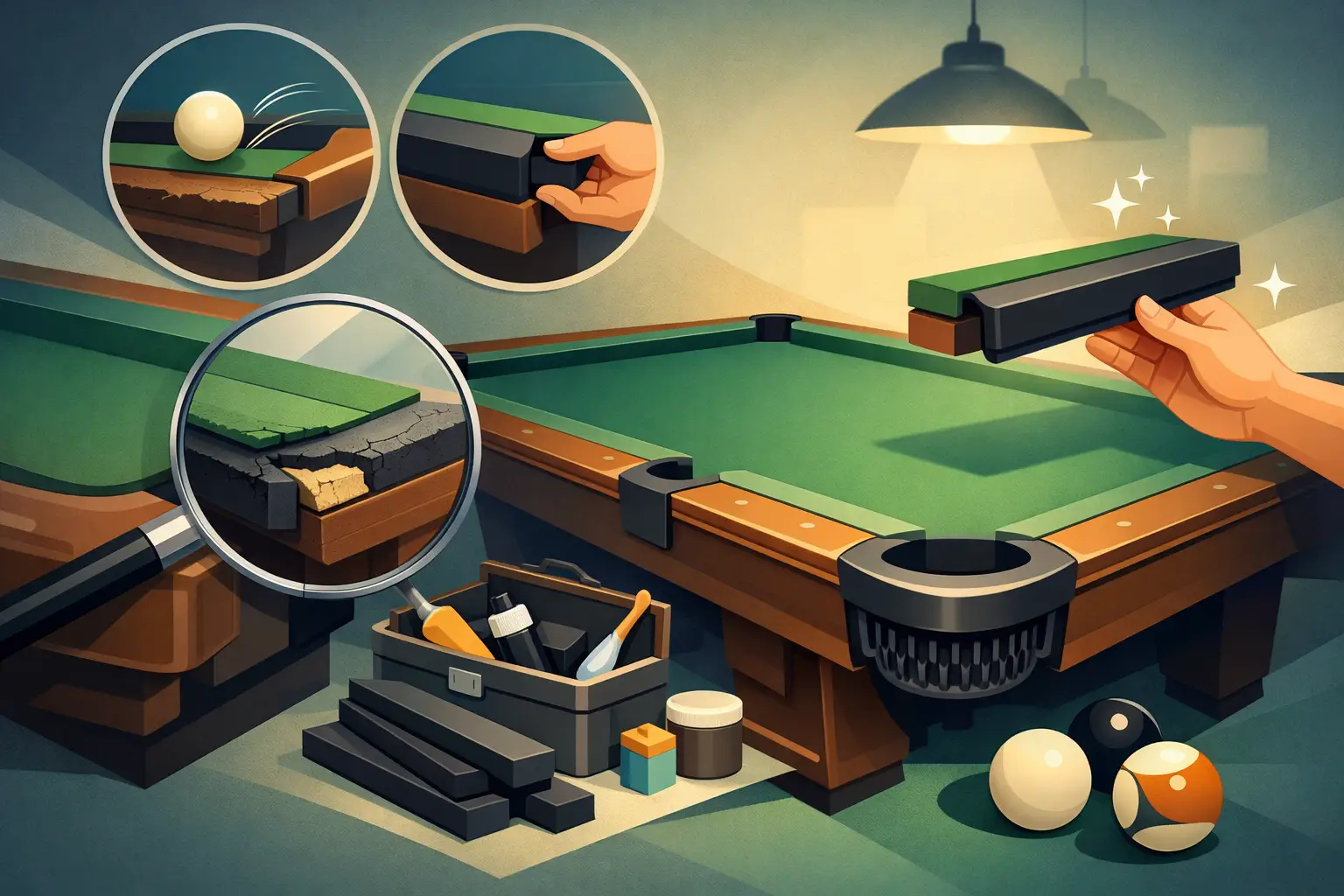
A ball that dies halfway down the rail, kicks out at an odd angle, or makes a dull thud instead of a crisp rebound is telling you something. Knowing when to replace pool table cushions helps protect more than a good game. It prevents you from spending money on new cloth or a full restoration while leaving the part that controls bank shots, speed, and consistency in poor condition.
Pool table cushions are not designed to last forever. The rubber inside the rails gradually changes with age, temperature swings, sunlight, and dry indoor air. A table can still look excellent from across the room while the rails have become too hard, too soft, loose, or uneven for accurate play.
1. The Ball Does Not Rebound Consistently
The clearest sign of worn cushions is inconsistent rebound. Roll or lightly shoot a ball into several places along the same rail. If it comes off one area sharply but feels slow, dead, or unpredictable farther down, the cushion rubber may be failing.
A healthy cushion should return the ball with a lively, consistent response. It does not need to play like a tournament table to be in good shape, but the reaction should be dependable from end to end. When players start compensating for certain "dead spots," the problem is usually not their stroke.
Before replacing cushions, a professional should inspect the rail attachment and table level. Loose rail bolts, warped rail components, and an unlevel slate can all affect how a ball behaves. Still, if the rails are secure and the table is level, uneven rebound is a strong reason to replace the rubber.
2. The Rubber Feels Hard, Dry, or Crumbly
Rubber cushions age even when a table is rarely used. In fact, a table stored in a basement, garage, seasonal home, or unused recreation room may develop hardened rails without seeing much play.
Press gently along the face of the cushion beneath the cloth. Good rubber has some firm resilience. It should not feel brittle, rock-hard, cracked, or so soft that it compresses without springing back. In severe cases, old rubber can crumble at the edges or separate from the rail backing.
Humidity and temperature matter in the Hudson Valley. A table exposed to hot summers, cold winters, damp basements, or direct sun may wear out sooner than one kept in a stable, climate-controlled room. That is why age alone is not a complete answer. Condition and playing response matter more.
3. You Hear a Dull Thud Instead of a Clean Hit
Sound is a useful diagnostic tool. When a ball contacts a properly installed, healthy cushion, the sound is clean and solid. When the rubber has hardened or detached, the impact can sound flat, hollow, or unusually loud.
A dull sound does not always mean every cushion on the table needs replacement. Sometimes the issue is limited to one rail, one loose section, or a rail that was not properly reinstalled after a move. However, replacing only one cushion on an older table can create a mismatch in response. If the remaining rails are the same age, it is often wiser to inspect the entire set and replace them together.
4. The Cushion Is Separating From the Rail
Look closely where the cloth meets the cushion and at the ends near the pockets. You may see gaps, bulges, lifting rubber, loose cloth, or a cushion that no longer sits straight against the rail.
Separation can happen when old adhesive fails, especially after years of changing temperatures. It can also result from improper prior repair work or from rails being handled roughly during a move. Once the rubber moves out of position, pocket angles and ball rebound can change noticeably.
This is not a repair to handle with household glue. The old rubber must be removed cleanly, the rail surface prepared, and the new cushion fitted at the correct height and angle before the rail is recovered. Small errors can produce poor rebound, exposed cushion edges, or pockets that play incorrectly.
5. Bank Shots Start Playing Wrong
Players who know their table often notice cushion trouble before they see it. A familiar cross-corner bank suddenly comes short. A long rail-first shot comes off too wide. One side of the table plays faster than the other.
There is some normal variation between table sizes, cloth types, humidity levels, and shot speed. New cloth may also make a table feel faster than worn cloth. But cushion rubber should not force a player to guess whether a standard bank will react differently based on where it strikes the rail.
If the issue is consistent across the table, the rubber may be uniformly hardened. If it occurs only in a few areas, there may be localized cushion failure or a rail installation issue. Either way, a hands-on inspection is the right next step.
When to Replace Pool Table Cushions During Other Work
Cushion replacement makes the most sense when the rails are already coming apart for related service. If you are refelting a table, restoring an older model, repairing damaged rails, or setting up a used table after a move, it is the ideal time to evaluate the rubber.
New cloth cannot correct dead rails. In some cases, customers invest in fresh felt only to discover that the table still does not play properly because the cushions are old. Inspecting the rails before cloth is installed avoids doing the same labor twice.
This does not mean every refelting job requires new cushions. If the rubber is still responsive, firmly attached, and even across all rails, keeping it can be the practical choice. The value is in making that decision based on the actual condition of the table, not on appearance alone.
Age Is a Clue, Not a Deadline
Many pool table cushions last 15 to 25 years, and some last longer under favorable conditions. Others fail sooner because of poor storage, low-quality rubber, sun exposure, or environmental changes. A table from the 1970s or 1980s that has never had rail work is very likely due for inspection, but even a newer table can have problems if it has been stored improperly.
The brand of table and the quality of the original cushion rubber also affect lifespan. Well-built tables often have rails worth restoring, while lower-cost tables may need a closer structural assessment before investing in new rubber. A professional can evaluate the frame, slate support, rail condition, and pocket irons alongside the cushions, so the repair supports the table as a whole.
Why Proper Cushion Installation Matters
Replacing pool table cushions is precision work, not simply gluing rubber to wood. The cushion profile must match the rail design, and its height must be set correctly in relation to the playing surface. The facing material at each pocket also affects how balls enter or reject from the pocket.
A cushion installed too high can cause balls to jump. One installed too low can create weak or inconsistent rebound. Poor alignment can make rails look uneven beneath the cloth and change the way balls travel into the pocket points. Even quality rubber will not perform correctly if the rail work is inaccurate.
That is why the rail should be handled as part of a complete performance system: slate level, tight rail installation, correct cushion height, clean cloth fitting, and proper pocket geometry. TableSmith Installations approaches rail work with the same care used for professional pool table relocation services and precision leveling. The goal is not just a table that looks refreshed, but one that plays true when the work is finished.
What to Do If You Suspect Dead Cushions
Start with a simple test on a level, clean table. Shoot a ball gently into several points along each rail and compare the response. Listen for changes in sound, watch for uneven rebound, and inspect the cushion line for gaps or bulges. Avoid pulling the cloth back or trying to inject adhesive through it, as that can make a proper repair more difficult.
If the table is being moved, mention the rail concern before the appointment. Disassembly provides a practical opportunity to inspect the underside of the rails and plan any needed restoration work before the table is reassembled in its new room.
A pool table should reward a well-played shot, not punish it because aging rubber has changed the game. When the rails stop giving you a clean, predictable return, a careful inspection can bring the table back to the crisp, confident play your game room deserves.