
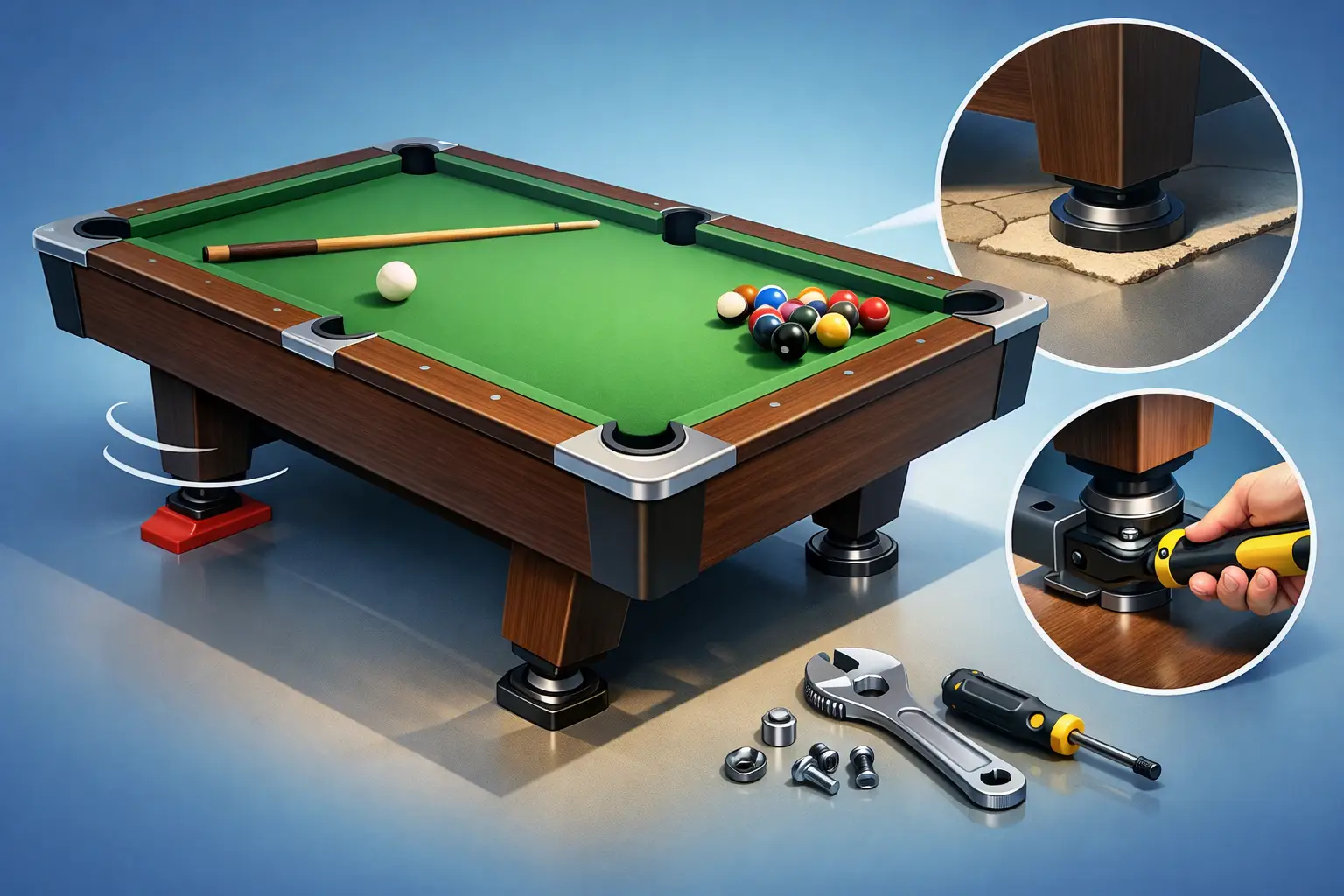
A pool table should feel planted. When you lean on a rail, rack a game, or break, the cabinet should not shift beneath you. Yet wobble is one of the most common problems homeowners notice after a move, a renovation, or years of regular use. Understanding why pool tables wobble matters because a table that moves can quickly become a table that plays unevenly, strains its frame, or develops avoidable damage.
A slight movement may seem harmless, especially if the balls still roll reasonably well. But a quality billiard table is a system: cabinet, legs, cross members, slate, rails, bolts, and cloth all work together. If the base is not stable, precise leveling at the playing surface will not hold the way it should.
Why Pool Tables Wobble in the First Place
The most obvious cause is an uneven floor. Many homes have floors that slope slightly, settle over time, or change from one section of the room to another. Hardwood floors can have subtle variation between joists. Finished basements may have a low spot. Carpet and thick padding can compress differently under each leg. Even a small difference at the floor can make a heavy table rock from corner to corner.
That said, the floor is not always the whole story. A pool table can wobble because one leg is not carrying weight evenly, because a leg leveler has shifted, or because a previous installer used shims that have compressed or slipped. On tables with adjustable feet, an adjustment may have backed off over time. On older tables, the wooden leg itself may be worn, cracked, or no longer square where it meets the cabinet.
The cabinet and frame deserve close attention as well. Pool tables are heavy, particularly slate models. When a table is pushed across a room, lifted improperly, or transported while assembled, the stress can loosen leg bolts, corner hardware, and internal frame connections. The table may look fine at first glance but shift when pressure is applied to a rail.
A wobble can also appear after a relocation. Moving a pool table is not like moving a dining table. Slate sections need to be removed, supported, and transported correctly. The cabinet must be disassembled only where appropriate and protected from twisting. Once the table is in its new location, it must be reassembled, secured, and leveled from the structure upward. Setting the slate back on a frame that is not stable simply hides the real issue for a while.
A Wobbling Table Is Not Just a Leveling Problem
People often use the words “wobbling” and “unlevel” interchangeably, but they are different conditions. A table can be stable and still be out of level. It can also be level at one moment yet rock when someone rests an elbow on the rail. Proper service addresses both.
Leveling is about creating a true playing plane so balls roll consistently in every direction. Stability is about ensuring the cabinet and legs stay fixed under normal use. If the base shifts, the slate can flex slightly or settle differently. That affects the level, puts stress on seams, and may eventually show up as a roll-off that was not there before.
This is particularly important with three-piece slate tables. Each slate piece must sit correctly on the frame, align with the adjoining sections, and be leveled with precision. The seams are then filled and prepared before cloth is installed. If the cabinet rocks, the work beneath the cloth can be compromised. A ball that drifts toward a side pocket may be telling you more than “the table needs a quick adjustment.”
Common Signs the Problem Is Structural
A table that moves only on one corner is often dealing with uneven contact at a leg or foot. A table that feels loose across an entire side may point to loose cabinet hardware or a frame issue. Listen for creaking, clicking, or a change in movement when weight is applied to different rails. Those clues help identify whether the table needs simple adjustment or a more involved repair.
Pay attention to the rails, too. If a rail feels loose, do not assume it is causing the wobble by itself. Rails attach to the slate and play an important role in how the table performs, but they are not meant to compensate for an unstable base. Tightening a few visible bolts without checking the frame can create uneven pressure or mask a problem that should be corrected properly.
Older tables may have additional concerns. Wood can dry, split, or soften after years in a damp basement, garage, or poorly controlled storage space. Decorative leg assemblies can loosen internally. Particleboard or lower-grade cabinet components can swell after moisture exposure. In these cases, shimming a leg might reduce the movement temporarily, but it does not restore the table’s underlying support.
How to Check a Wobbling Pool Table Safely
Start with a simple check. With the table empty, place gentle pressure on each corner of the cabinet, not the center of the playing surface. Notice whether it rocks in a consistent direction and whether the movement is concentrated at one leg. Look underneath for a missing leveler, damaged foot pad, loose bolt, or a visible gap between a leg and the floor.
Avoid aggressively shaking the table or standing on the rails. Slate is durable when supported correctly, but it is not indestructible. A sharp impact, unsupported lift, or forced twist can crack slate, damage a frame, or disturb rail alignment. It is also best not to slide a slate table across the floor in an attempt to find a flatter spot. That can damage flooring and place unnecessary stress on the cabinet.
A small carpenter’s level can reveal obvious slope, but it cannot replace precision billiard leveling. The slate may have variation that is not visible from the cabinet alone, and a table can require adjustment at multiple points. A proper assessment checks the floor, leg contact, frame stability, slate support, seams, rail fit, and actual ball roll.
Why Random Shims Can Make Things Worse
A folded piece of cardboard, wood scrap, or furniture pad under a leg can stop a rock for the moment. The trade-off is that improvised shims often compress, shift, absorb moisture, or create a pressure point. They may also raise one side enough to affect the playing surface.
There are cases where controlled shimming is part of a correct installation. The difference is placement, material, and what is being adjusted. A professional does not use a shim as a guess. The table is evaluated from the base through the slate, and each adjustment is made to create stable support while preserving accurate level.
If your table sits on carpet, the issue can be more complicated. Fresh carpet and padding may settle under the table’s weight after installation. In a renovated room, flooring transitions or new subfloor work can create changes that were not present before. It depends on the table’s construction, its weight, and the condition of the floor beneath it.
When Professional Pool Table Leveling Makes Sense
If the table has recently been moved, has a noticeable rocking motion, or no longer plays true, professional service is the sensible next step. This is especially true for slate tables, antique tables, and any table you want to protect for the long term.
At TableSmith Installations, the work begins with the structure, not just a level placed on the cloth. A stable cabinet, properly supported slate, secure rails, and accurate leveling all contribute to the way a table plays. If loose hardware, worn components, damaged cushions, or old cloth are part of the issue, those can be addressed as part of the same careful service rather than treated as unrelated problems.
Professional help is also worthwhile after purchasing a used table. A used table may have been disassembled by someone unfamiliar with billiard construction, stored in a damp location, or reassembled without precise leveling. An inspection during setup can identify problems before new cloth goes on or before a minor wobble becomes a more expensive repair.
Keep the Table Stable After It Is Fixed
Once a table is properly installed and leveled, treat it as fixed equipment. Do not drag it to make room for guests or move it during cleaning. Keep excessive moisture away from the legs and cabinet, and avoid using the rails as seats or work surfaces. If flooring work, a renovation, or water damage affects the room, have the table checked afterward.
A stable, true-playing pool table changes the whole game room experience. Balls roll where they should, rails feel solid, and every shot is decided by the player rather than a shifting cabinet. If your table rocks, do not keep playing around it. A careful inspection now can protect the slate, the frame, and the investment sitting at the center of your home game room.