
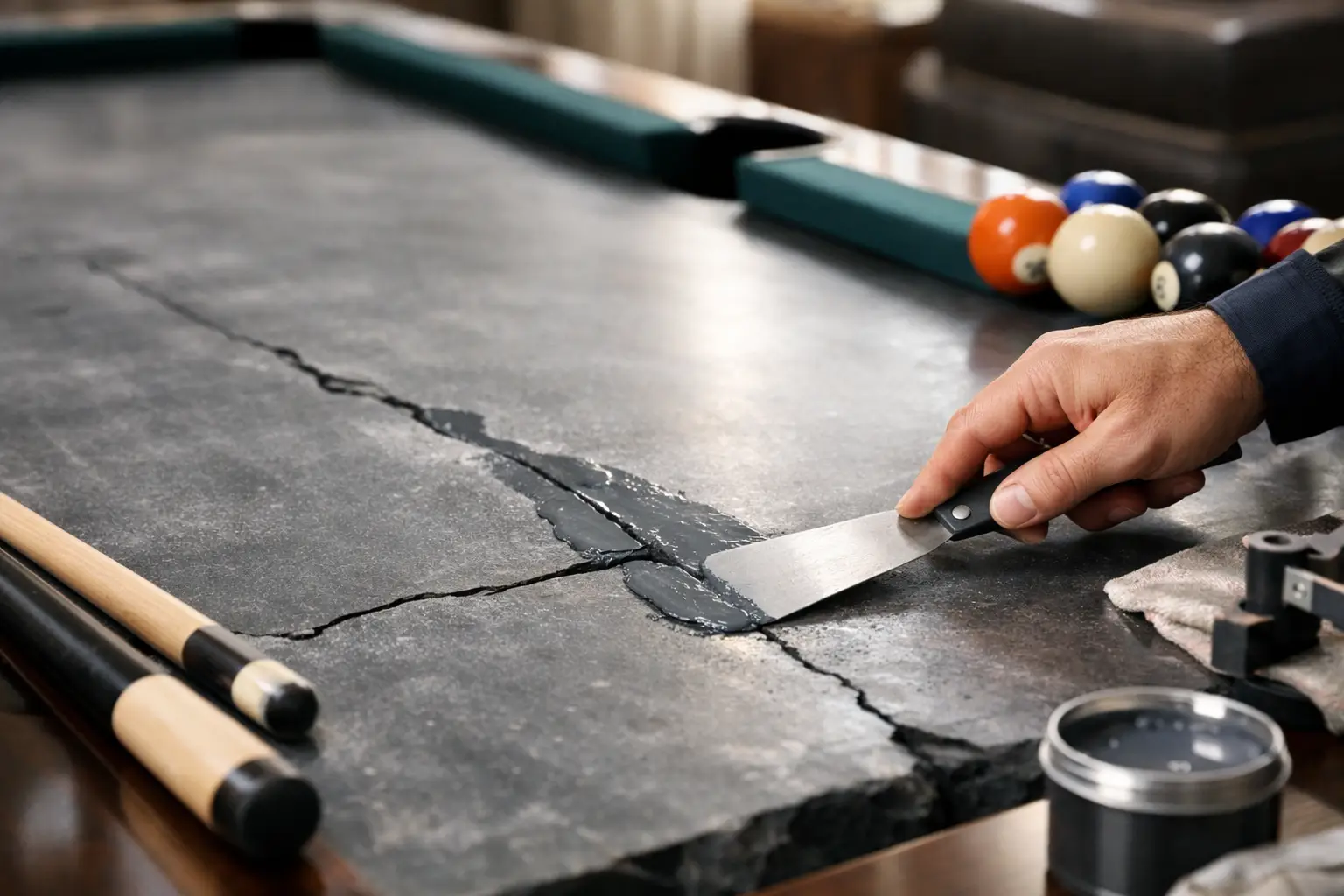
A pool ball that consistently hops, rolls off line, or changes direction over one area of the table may point to a problem below the cloth. Pool table slate crack repair can sometimes restore a usable playing surface, but it is not a cosmetic patch-and-forget job. The repair has to address the crack itself, the support beneath the slate, the seams between slate pieces, and the final level of the table.
For homeowners, the biggest question is usually simple: can this slate be repaired, or does it need to be replaced? The honest answer depends on where the crack is, how severe it is, and whether the slate and cabinet can still be brought back to a stable, true-playing condition.
Why a Cracked Slate Changes How a Table Plays
Slate is used in quality pool tables because it is dense, stable, and capable of being machined exceptionally flat. Most home tables use three pieces of slate, although one-piece slate tables are also common. The slate rests on a wooden or metal frame, and the finished playing surface depends on all of those parts working together.
A crack disrupts that surface. Even a hairline break can become noticeable when the slate shifts under the cloth, when a seam opens, or when the repair material sits slightly proud of the surrounding surface. A few thousandths of an inch can affect a slow-rolling ball. On a well-set-up table, that matters.
Cracks often happen during a move. Slate is heavy and strong when properly supported, but it is brittle when carried flat without enough hands, set down on an uneven edge, or allowed to flex. They can also develop after a table has been moved without complete disassembly, after a frame has loosened, or when a heavy object is dropped on the playing surface.
First, Identify the Type of Slate Damage
Not every line under a pool table cloth is a crack. On a three-piece table, you may be seeing a slate seam. Seams are normal and are filled during installation so the cloth lays over a continuous surface. A proper seam should not affect ball travel.
A true crack usually has an irregular path, may extend through the slate, and can create movement or a raised edge. It may be visible from the underside of the table. If the cloth has a sharp crease, a persistent bump, or a tear in the same area, the damage may be more significant than a surface-level issue.
Hairline cracks and stable breaks
A fine crack in a low-stress area may be repairable when the slate pieces still fit tightly together and the table frame is sound. The key word is stable. If the two sides of the crack do not move independently and the break can be supported correctly from below, a skilled repair may provide a flat surface that plays well.
This kind of repair is still more involved than filling a visible line. The slate must be accessed, inspected, cleaned, aligned, bonded, and checked for flatness before new cloth is installed.
Broken corners, edges, and pocket areas
Damage around a pocket opening or outside edge deserves closer scrutiny. Those areas deal with rail bolts, pocket cuts, and less continuous slate material. A missing corner or edge chip can sometimes be rebuilt, particularly if it sits outside the main ball path. But if the break affects rail mounting, pocket geometry, or the slate's ability to sit securely on the frame, replacement may be the better long-term decision.
Major fractures through the playing field
A wide break, multiple intersecting cracks, or a fracture that leaves the slate in several loose pieces is a different situation. Repair may be possible in limited cases, but the cost and uncertainty can outweigh the value of the work. A replacement slate, a donor table, or a different table altogether may be more sensible.
That is not an automatic verdict. Some older tables have substantial furniture value, sentimental value, or construction quality worth preserving. The right path comes from evaluating the whole table, not just the damaged spot.
What Professional Pool Table Slate Crack Repair Involves
A dependable repair begins with a full inspection. The cloth and rails generally need to come off so the slate can be examined directly. The technician checks the crack from both sides, looks for old filler or previous repairs, confirms that the slate is supported, and inspects the cabinet crossmembers and leg structure.
The cracked sections are then carefully brought into alignment. Depending on the break, a suitable bonding material may be used to secure the slate, and additional support may be fitted beneath the damaged area. The goal is not simply to hold the pieces together. It is to prevent future flex while maintaining the original plane of the playing surface.
Once the repair is stable, the top is made smooth and checked for high or low spots. On a three-piece table, the existing slate seams are also addressed at this stage. After the slate is installed back on a level frame, it is precision leveled in multiple directions. Only then should the cloth go on.
This sequence matters. Filling a crack before correcting a weak support or an out-of-level frame leaves the underlying cause in place. The table may look finished for a while, then develop a ridge, a soft spot, or a roll issue as the structure settles.
Why DIY Repairs Often Fall Short
There are repair kits and internet tutorials that make slate repair sound straightforward. Some are useful for understanding the problem, but a homeowner should be cautious about treating a pool table like a countertop or a piece of drywall.
The cloth hides the repair, which makes it tempting to focus on appearance. Playing performance is less forgiving. Too much filler creates a high spot. Too little leaves a depression. Adhesive without proper support can allow the break to flex again. A repair that seems smooth by hand may still send a slow ball off course.
There is also the handling risk. A full-size slate section can weigh hundreds of pounds. Trying to remove it alone, lift it by an unsupported end, or carry it through stairs and tight turns can turn one crack into several. If the table needs to be moved before repair, it should be disassembled and transported as slate, rails, frame, and hardware - not dragged as a complete piece of furniture.
Repair or Replacement: Making the Practical Call
Repair is usually worth considering when the slate is otherwise flat, the break is limited, the frame is solid, and the table has enough value to justify careful restoration. It is particularly practical when the damage is discovered during a move and can be addressed before reassembly and new cloth installation.
Replacement becomes more attractive when the slate is badly fragmented, the crack crosses a high-use playing area with movement, the cabinet is weak, or the cost of labor approaches the value of the table. Used slate can be difficult to match. Thickness, dimensions, backing, pocket cuts, and rail bolt locations all need to match the table's design. A piece of slate that is merely close in size is not necessarily a workable replacement.
Sometimes the best value is a combined service plan: repair the stable slate damage, tighten or restore the frame, replace worn cushions if needed, install fresh cloth, and level the table correctly. That approach protects the table as a complete playing system rather than treating one visible issue in isolation.
Protect the Repair During Moving and Setup
After a successful repair, proper setup is what keeps it successful. The slate needs continuous support from a sound frame. Rail bolts should be tightened correctly, without forcing damaged components. The table should be leveled at the slate, not by guessing from the cabinet or floor alone.
Humidity and normal seasonal movement can affect a home's floors and a table's wood components, so periodic leveling may be worthwhile, especially after renovation work or a move. Avoid placing heavy items on the table, leaning on the rails, or attempting to shift the table across the floor in one piece.
For pool table owners in the Hudson Valley and throughout the Northeast, TableSmith Installations handles the inspection, careful disassembly, slate repair assessment, reassembly, and precision leveling that this work demands. A repaired slate deserves the same careful attention as a new installation.
If you suspect a crack, leave the cloth in place until it can be assessed unless it is already loose or damaged. Take clear photos of the area, note whether balls react at that location, and avoid playing over a raised break. Acting early can be the difference between a controlled repair and a more expensive restoration.